
Complex Behavior — Short Duration
Agentic complex-behaviour recognition — an AI agent that autonomously identifies patterns and events unfolding within seconds from standard video feeds, without scenario-specific model training.
Interactive simulation of a real-time agentic multi-camera tracking system. Multiple shoppers are monitored simultaneously across the store floor. When the AI agent detects concealment behaviour, the suspect is flagged in real-time and tracked across all camera views — no pre-training required.
Our agentic system autonomously analyzes retail footage in real-time, recognizing a wide range of theft patterns — from rapid grab-and-go to subtle concealment techniques — all within seconds of occurrence, without scenario-specific training.
Scenario 1 — Rapid Theft Detection
Fast-acting behavioural analysis identifies suspicious grab-and-go patterns within seconds of occurrence. The system distinguishes between normal browsing and theft-indicative movements using temporal action recognition.
Scenario 2 — Concealment Detection
Detects subtle concealment behaviours and hand-object interactions that indicate shoplifting attempts. The model tracks body pose, hand trajectories, and object visibility to identify concealment events with high confidence.
Short-Duration Analysis
Optimized for detecting rapid, complex behaviours that unfold within seconds — no long observation windows required. Latency from event to alert is under 2 seconds.
Real-Time Alerts
Instant notifications when suspicious behaviour is detected, enabling immediate security response and intervention. Integrates with existing alarm and dispatch systems via API.
Standard Cameras
Works with existing surveillance infrastructure — no special hardware or camera upgrades needed. Compatible with any IP camera outputting standard RTSP/ONVIF streams.
Complex Behavior — Long Duration
Agentic long-duration behaviour analysis — an AI agent that autonomously decomposes complex activities into sequential steps and verifies each one against configurable rule sets in real-time, without scenario-specific training.
Watch the agentic system autonomously decompose a multi-step operational procedure in real-time. Each step is independently detected, timed, and validated against configurable compliance rules — violations are flagged instantly with step-level granularity, no custom model training needed.
Automated Compliance Verification
Monitors extended activities by breaking them into discrete procedural steps — each step is independently validated against compliance rules. The system handles activities spanning minutes to hours with consistent accuracy.
- Automatic activity decomposition into steps
- Per-step validation against configurable rule sets
- Long-duration temporal reasoning (minutes to hours)
- Violation alerts with step-level granularity
- Applicable to safety, SOPs, and operational audits
Activity Detection
The system identifies when a monitored activity begins and starts tracking the subject through the defined workflow. Entry triggers are configurable — zone-based, object-based, or action-based.
Step Decomposition
Complex behaviours are automatically broken into individual sequential steps, each mapped to expected actions and timings. The model understands ordering, dependencies, and acceptable time windows for each step.
Rule Validation
Each step is verified against predefined rules — missing steps, wrong order, or timing violations trigger real-time alerts. Results are logged with full audit trail for review and reporting.
Manufacturing QA
Verify that assembly-line operators follow prescribed procedures in the correct order. Detect skipped steps, wrong tooling, or timing deviations before defective products leave the line.
Workplace Safety
Ensure PPE compliance, proper equipment handling, and safety-protocol adherence. The system monitors continuously without fatigue, covering every shift and every worker.
Operational Audits
Replace manual spot-check auditing with continuous automated monitoring. Generate compliance reports with timestamped evidence for every observed procedure.
Segmentation
Agentic multi-layered scene analysis — an AI agent that autonomously combines object detection, semantic segmentation, heatmap analytics, and contextual event understanding from standard video feeds.
A single camera feed from a complex urban intersection serves as input for all analysis modes below — demonstrating the depth of insight extractable from a single standard video source.
Original Recording
The source video used for all the segmentation analyses below — a complex urban intersection with multiple vehicle types and pedestrians. No preprocessing or special camera setup required.
From a single video source, the system generates multiple parallel analysis layers — each providing different operational insights that can be used independently or combined for comprehensive scene understanding.
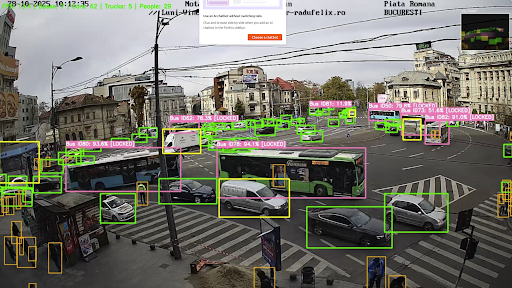
Traffic Segmentation
Per-class bounding-box detection with color-coded categories — buses, cars, pedestrians — with live counting and statistics. Real-time object tracking maintains identity across frames.
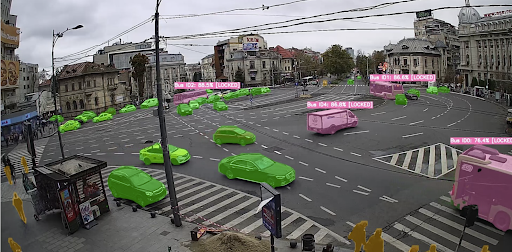
Semantic Segmentation
Pixel-level scene understanding with full color-mask overlay — every vehicle classified and segmented at instance level. Enables precise area-based analytics and spatial reasoning.
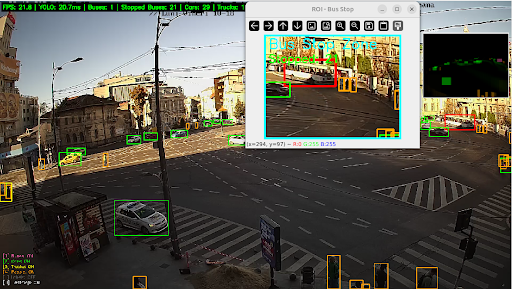
Bus Stop Analytics
Contextual event detection for public transport — identifying stopped buses, boarding zones, and dwell-time analysis. Automated reporting for transit operations.
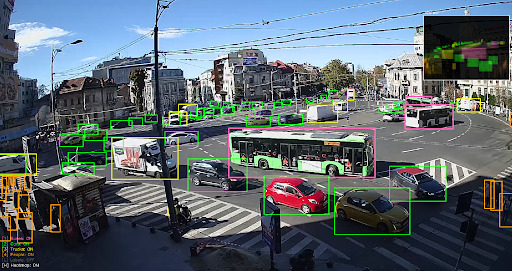
Traffic Density Heatmap
Accumulated movement data visualized as a heat overlay on the live detection feed, with a mini-map for spatial context.
- Temporal accumulation of vehicle paths
- Hotspot identification for congestion
- Combined with real-time object detection
- Mini-map overlay for spatial orientation
Multi-Layer Analysis
Run detection, segmentation, heatmapping, and event detection simultaneously on the same feed — each layer provides independent operational insights.
Real-Time Processing
All analysis runs at video frame rate with no perceptible delay. Results stream directly to dashboards, APIs, or alerting systems for immediate consumption.
Dashboard Ready
Output formatted for direct integration with monitoring dashboards. JSON/REST APIs, WebSocket streams, and webhook callbacks supported out of the box.
Custom Object Detection — Low Cost
Custom-trained detection models built for your specific use case and optimized for cost-effective hardware — from aerial footage to any deployment scenario. We handle the full training pipeline so you get production-grade accuracy on devices as small as a Raspberry Pi.
Real-time object detection running on drone-captured aerial footage. The model was custom-trained for this specific use case and optimized to run on low-power embedded hardware without sacrificing detection accuracy.
Aerial Object Detection
Custom-trained detection models running on drone-captured footage — optimized for low-cost hardware while maintaining high accuracy on aerial perspectives. The model handles varying altitudes, angles, and lighting conditions.
- Custom object detection from aerial view
- Runs on Raspberry Pi, Jetson, and mobile phones
- Handles altitude and angle variations
- Lightweight models for edge deployment
- Real-time inference on embedded devices
Cost-Effective
Runs on a Raspberry Pi, consumer-grade drones, or even mobile phones — making computer vision accessible for any budget. No GPU servers required, all inference runs on-device.
Custom Training
Models trained specifically for your target objects and environments — agriculture, infrastructure, security, and more. We handle the full pipeline: data collection, annotation, training, and optimization.
Edge Deployment
Optimized for on-device inference — no cloud dependency, low latency, works in areas with limited connectivity. Models are quantized and compiled for target hardware.
Raspberry Pi / Jetson
Runs natively on Raspberry Pi 4/5, NVIDIA Jetson (Nano, Xavier, Orin), and Google Coral Edge TPU. Full inference pipeline included with hardware-specific optimizations.
Mobile Phones
Deploy directly on iOS and Android devices. Models are optimized for mobile NPUs and GPUs, enabling real-time detection through the phone camera with no server connection needed.
Cloud / Hybrid
Deploy the same models on cloud GPU instances for centralized processing, or use a hybrid approach with edge pre-filtering and cloud-based deep analysis.